One Number Builds the Whole Soldier
The Legion Builder Nexus is where the armies of Rememhal are forged, soldier by soldier. Every unit that marches under a banner — from a wandering duelist to a starfighter pilot — begins as a single value: its Soul Quantity. That one number quietly decides the soldier's rank, its combat statistics, and the Soulons it costs to keep in service each year. Everything else — the weapon it carries, the doctrine that fuels it, the role it plays on the field — is the creator's choice. This page breaks down how those pieces fit together.
Reading a Legion Sheet
Every unit is presented on a three-panel sheet. The artwork is the centerpiece — it doesn't just illustrate the soldier, it communicates everything a commander needs to know at a glance.
Equipment & Identity Showcase
A curated display of the iconic objects tied to the unit — primary and secondary weapons, banners, totems, relics, cultural ornaments. Not alternate versions of the soldier, just the pieces that define its battlefield identity.
The Main Soldier
A full-body, front-facing illustration in the Rememhal Signature Style, standing neutrally against a dark parchment background. This is the definitive image of the recruitable unit — usually anonymous, face concealed by helm, mask, or hood unless its culture calls for otherwise.
Unit Information
All gameplay data — name, species, classification, stats, abilities, traits, rank, and cost — organized into elegant parchment-style cards beside the artwork.
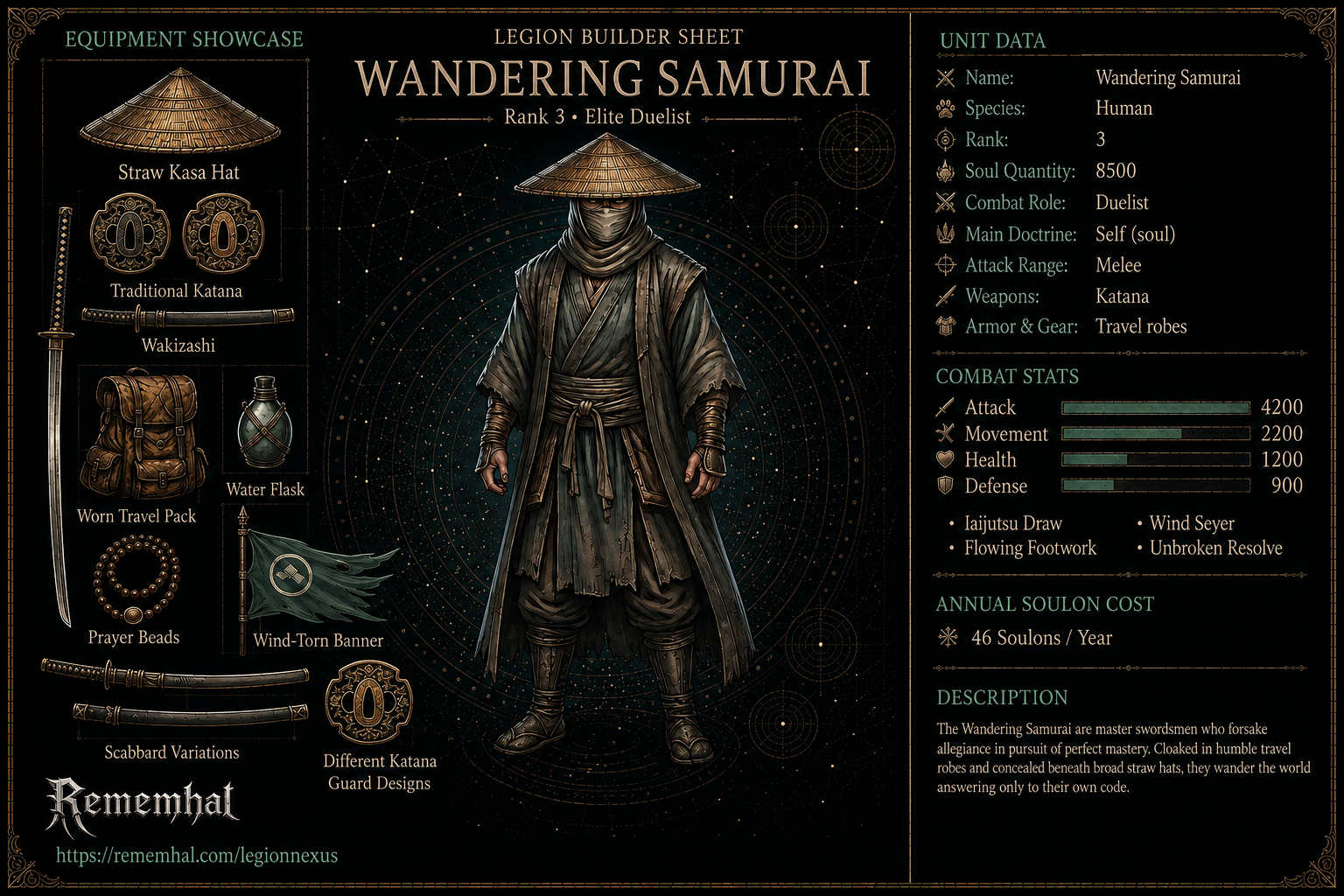
A completed sheet for the Wandering Samurai — equipment showcase, soldier artwork, and unit data side by side.
Identity & Classification
Before any numbers come into play, a unit needs an identity and a way of fighting. These fields describe who the soldier is and how it behaves on the field — not how powerful it is.
Name & Species
The unit's name, and its species — Human, Elf, Orc, Dwarf, Insectoid, Beastfolk, Automaton, Dragonkin, Undead, Demon, and more.
Description
A short lore paragraph explaining the soldier and the purpose it serves in battle.
Combat Role
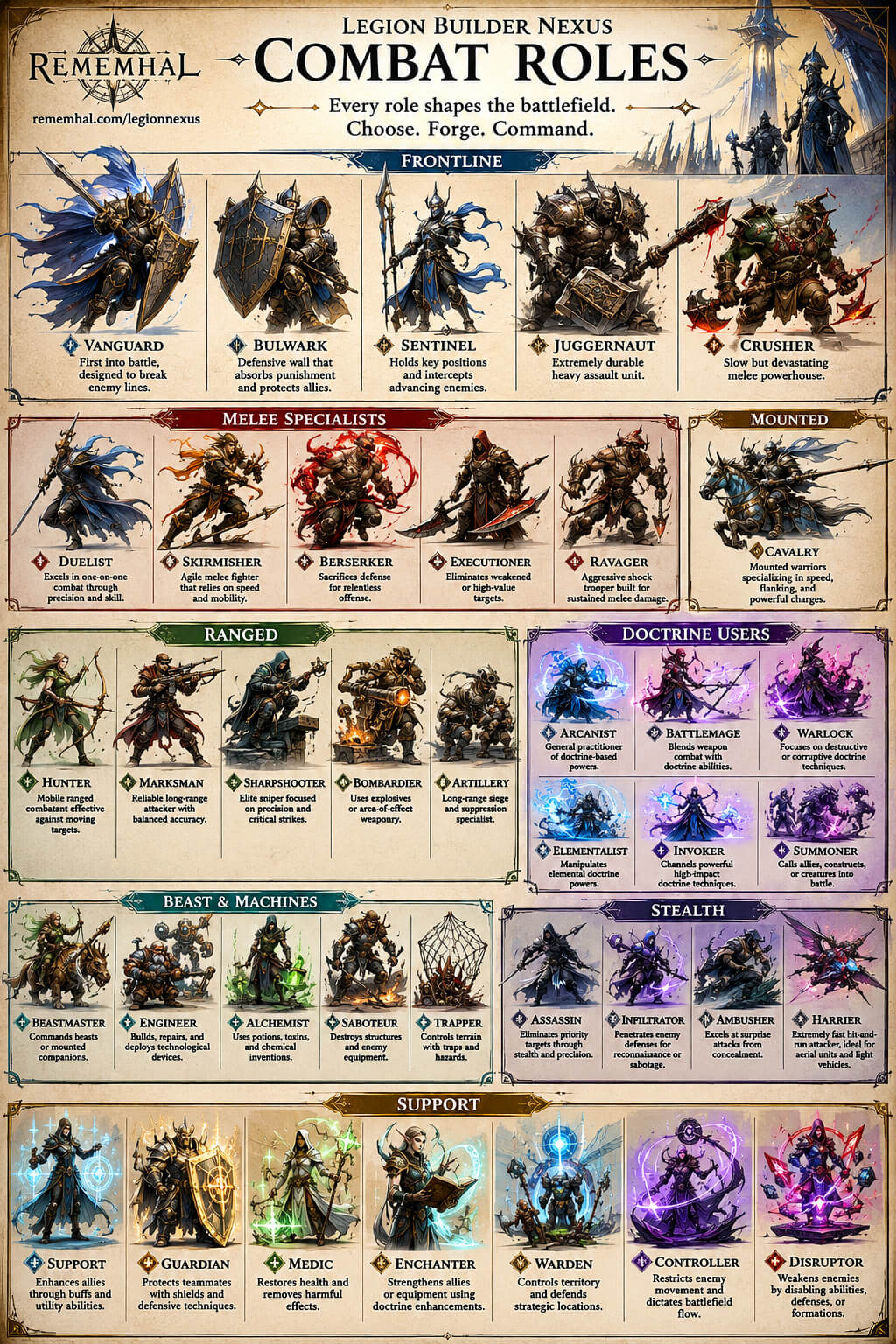
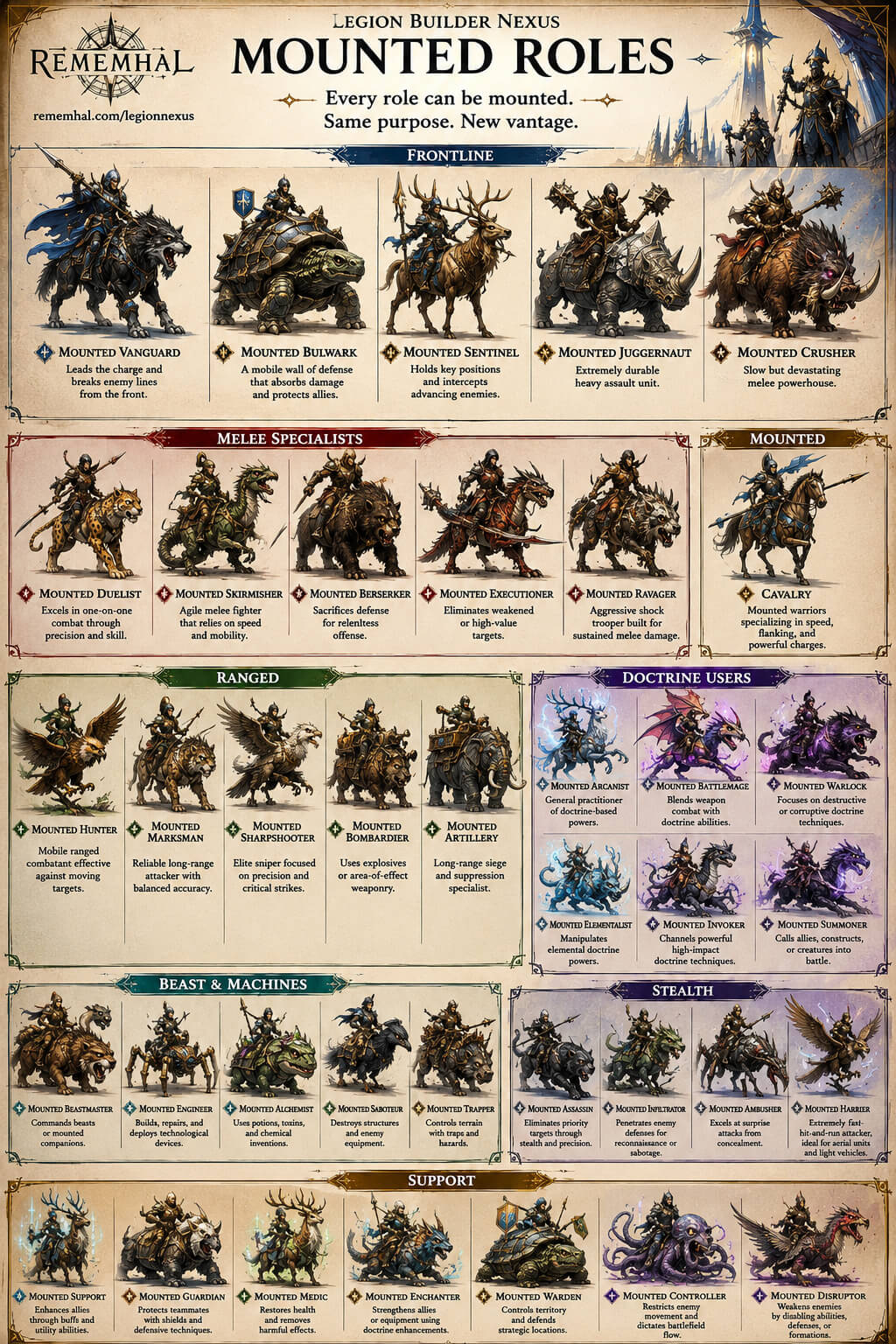
How the unit fights, not what it fights with. Every combat role in the Legion Builder Nexus, explained:
Main Doctrine of Power
One of Rememhal's 17 Doctrines of Power — the supernatural source behind the unit's abilities. A soldier could have multiple doctrines of power, but this represents what this type of soldiers typically hone as their primary one.
Weapon Loadout
One fixed, thematic loadout per unit — what it physically fights with.
Armor & Gear, Attack Range
Armor describes appearance and protection — from chainmail to powered exosuits. Attack Range fixes how close the unit needs to be: Melee, Short, Medium, Long, or Extreme.
Soul Quantity: The Heart of Every Soldier
Soul Quantity (SQ) represents the total spiritual energy held within a soldier's soul. It's the single most important number on the sheet — the creator enters it once, and three other fields fall out of it automatically.
| Rank | Soul Quantity Range | Annual Soulon Cost |
|---|---|---|
| Rank 1 | 1 – 250 | 0 – 7 / year |
| Rank 2 | 251 – 1,000 | 7 – 15 / year |
| Rank 3 | 1,001 – 9,999 | 15 – 49 / year |
Combat Statistics: Spending the Soul Pool
Health, Attack, Defense, and Movement are distributed out of the unit's Soul Quantity, and must always add back up to it exactly:
Two units with the same Soul Quantity are, in principle, equally powerful overall — they're simply specialized differently. A glass-cannon assassin and a stone-wall guardian can share a total without playing anything alike.
Rank 1 Scout
Soul Quantity 200Rank 2 Guardian
Soul Quantity 800Rank 3 Assassin
Soul Quantity 4,500Annual Soulon Cost
Hiring cost is never set by hand — it's calculated straight from Soul Quantity, so a soldier's price always tracks its true power.
| Soul Quantity | √SQ | Annual Cost |
|---|---|---|
| 100 | 10 | 5 Soulons |
| 900 | 30 | 15 Soulons |
| 4,900 | 70 | 35 Soulons |
| 8,500 | 92.2 | 46 Soulons |
Abilities & Special Traits
The last two fields give the soldier its personality in combat.
Abilities
One to four unique active abilities the soldier can perform — fueled by its Main Doctrine of Power.
Special Traits
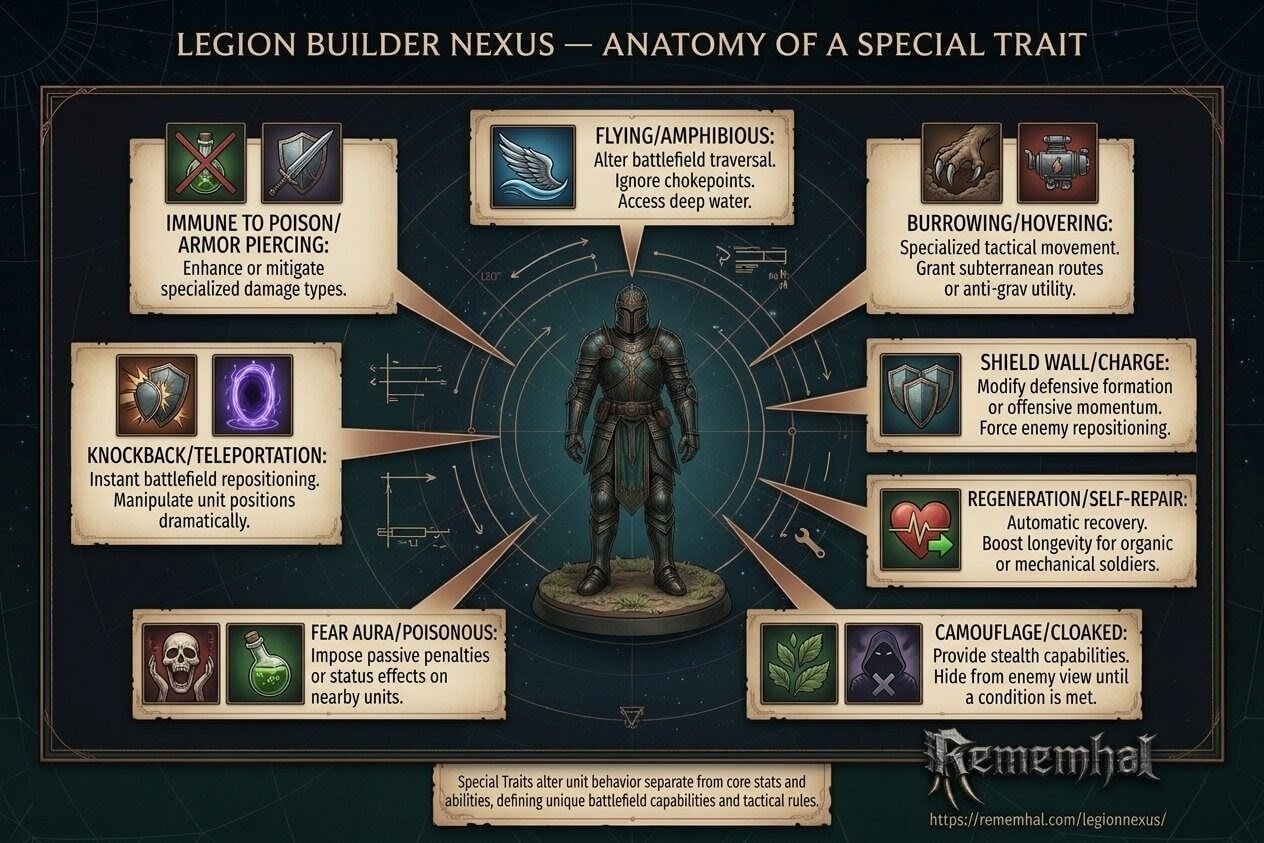
Innate, always-on characteristics that define the unit — Flying, Regeneration, Armor Piercing, Cloaked, Berserk, and dozens more.
Power Without a Hierarchy of Weapons
The Legion Builder Nexus only defines what a soldier is at the moment of recruitment. Combat Role defines how it behaves; Weapon Loadout defines what it fights with; Armor & Gear defines how it looks and how protected it is; Doctrine defines the energy behind its abilities; Rank defines its overall power.
Because every supernatural ability draws from one of the 17 Doctrines of Power, a unit's true effectiveness comes from its doctrine, role, abilities, and tactics — never simply from the weapon in its hand.
From the Ledger
Wandering Samurai
A disciplined swordsman who channels doctrine energy through a single katana. Calm, patient, and deadly in close combat, relying on precision rather than brute force.
- Doctrine
- Self (Soul)
- Weapon
- Katana
- Armor
- Traveler's Robes
- Range
- Melee
- Soul Qty
- 8,500
- Cost
- 46 Soulons / year
Abilities
Starfighter Pilot
Elite pilots who wield doctrine-powered starfighters, overwhelming enemies with rapid energy volleys before vanishing at incredible speed.
- Doctrine
- Artificial Doctrine
- Weapon
- Twin Laser Cannons
- Armor
- Space Flight Suit
- Range
- Long
- Soul Qty
- 3,600
- Cost
- 30 Soulons / year
Abilities
Special Traits
